
Nature has a gift for bringing forth fascinating organisms. Among the most interesting of them is undoubtedly Cordyceps – a parasitic fungus that has drawn the attention of the people of Tibet and China for centuries, and today of mycologists all over the world.
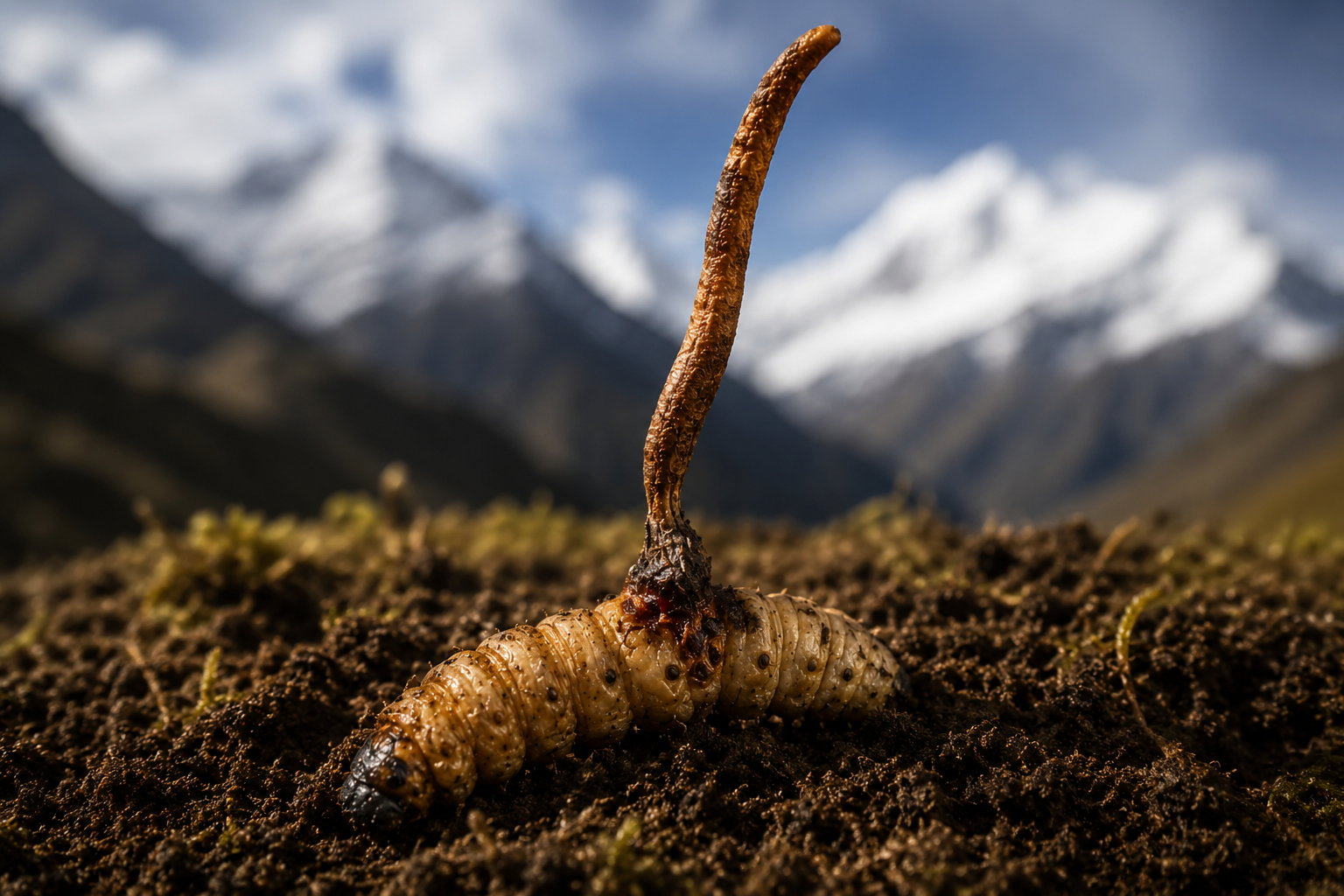
At first glance it looks unremarkable: a shrivelled larva with a dark stalk growing out of its head. Look closely at its life cycle, though, and you find it reads more like the script of a science-fiction film than like an ordinary mushroom. And that is no coincidence – fungi from this group served as the model for one of the best-known computer games of the past decade, and for the television series that grew out of it.
How does Cordyceps come about?
In the wild, Cordyceps attacks the larvae and caterpillars of certain insect species. In the case of the best-known species these are the larvae of ghost moths of the genus Thitarodes, which live in the soil of the high-altitude pastures of Tibet, Nepal and western China, at heights of roughly 3,000 to 5,000 metres.
Microscopic spores find their way into the host’s body and form a mycelium – a network of fine threads. These consume the nutrients inside the larva and gradually fill almost its entire body. In the end nothing is left of the larva but the outer shell, replaced from within entirely by fungal matter. Its shape and segments are kept intact, so to the eye it is still a caterpillar – only hard and as light as a dry twig.
Once its development is complete, the fungus forms a fruiting body: a narrow stalk a few centimetres long, which breaks out of the host’s head and grows up above the surface of the soil. There the spores ripen and the cycle can begin again. It is this course of events that gave the fungus its common name, the Chinese caterpillar fungus.
The genus Cordyceps and its close relatives are no exception in nature, either. There are several hundred species in all, and most of them are narrowly specialised – one species of fungus picks out one species, or a narrow group, of insects, and will not take hold on any other host.
A fungus that alters its host’s behaviour
Some species are able to influence the behaviour of their host so as to win the best possible conditions for their own reproduction. The best-described example is the tropical species Ophiocordyceps unilateralis and ants.
An infected ant leaves the colony of its own kind, climbs up a stem to a certain height, bites into the veins of a leaf and stays locked in that grip to the very end. The fungus brings it exactly to the place where the humidity and the temperature suit it best – and then a stalk grows out of the ant’s head, from which the spores rain down onto the ant trail beneath the leaf. Hence the nickname „zombie-ant fungus“.
These fungi are not dangerous to people. They are tied to insect hosts and cannot stand the body temperature of warm-blooded animals, so the scenario from the films and games stays a scenario.
A name that tells the whole story
Tibetan herders know the fungus as „yartsa gunbu“, which means „summer grass, winter worm“. The Chinese 冬虫夏草 (dongchong xiacao) says the same thing the other way round: „winter worm, summer grass“. Both names come from the way the gatherers made sense of the whole thing – in winter an animal under the ground, in summer a plant growing out of it. People had been noticing these shapes rising from the pastures for generations; that it was a fungus, and not grass growing out of a worm, became clear only much later.
The Latin Cordyceps is built from the words for a club and a head, in other words „club-head“ – an exact description of what grows out of the larva. In 2007, moreover, mycologists split the genus up and the Chinese caterpillar fungus moved into the genus Ophiocordyceps; its correct name is therefore Ophiocordyceps sinensis. On supplement labels, however, the older and well-established name Cordyceps sinensis has stuck.
How Cordyceps is gathered
The season starts at the end of May, as soon as the snow melts on the high pastures, and it lasts only a few weeks. Whole families move up to tented camps above the tree line for that time.
The gathering itself is fiddly, exhausting work: the gatherer moves along on their knees, eyes sweeping the ground, because what they are after is a dark stalk a few centimetres high that is barely distinguishable from a dry blade of grass. A good day means a few dozen pieces. Each find is carefully dug out whole, larva and all, and the soil is brushed off it – a broken or damaged piece is worth markedly less.
The fungus is then sorted by size, wholeness and colour and travels on through local buyers and markets to the big cities. For many herding households these few weeks are the main source of ready money for the whole year, so an entire seasonal economy has grown up around the gathering, rights to particular pastures included.
All that interest comes at a price, though. Yields from wild sites have been falling for years, and in 2020 the Chinese caterpillar fungus was placed on the IUCN Red List as a vulnerable species. Some countries regulate the gathering with permits – Bhutan, for instance, lifted its ban only in 2004 and has limited it by a permit system ever since.
A point of interest: Himalayan gold
In some parts of Tibet, wild Cordyceps is known as „Himalayan gold“. The reason is simple: the gathering is demanding, the occurrence limited, and none of it can be hurried along. The price of the finest specimens can run into thousands or even tens of thousands of euros per kilogram, which makes it one of the most valuable natural raw materials in the world.
With a price like that come the frauds. Pieces glued together from fragments, or sold with a wire or a scrap of metal inside to add weight, have been documented on Asian markets. It is one of the reasons why food supplements are made with controlled cultivation and with an extract whose content can be checked in a laboratory, rather than by buying whole specimens at a market.
What is to be found in Cordyceps
The chemical make-up of this fungus is an interesting subject in itself. The substances most often listed in it are:
- polysaccharides,
- beta-glucans,
- adenosine,
- cordycepin,
- the sugar alcohol mannitol, given in older literature as cordycepic acid.
Cordycepin is the oddest of them. Chemically it is 3’-deoxyadenosine, that is to say a molecule of adenosine missing one oxygen atom – what is known as a nucleoside analogue. It was isolated in 1950, and not from the Chinese caterpillar fungus but from a related species, Cordyceps militaris. It is substances like these that are the subject of a good many laboratory and academic papers devoted to the fungi of this group.
The content varies according to the species of fungus, according to which part is processed, and according to the growing conditions and the method of extraction. That is why, with extracts, it makes sense to watch the declared content of specific substances rather than just the name of the fungus on the packaging.
Cordyceps sinensis and Cordyceps militaris – what is the difference?
Say the word Cordyceps and most people picture the Chinese caterpillar fungus from the Tibetan plateau. On the supplement market, though, you will commonly come across both species, and it does no harm to know how they differ.
Cordyceps sinensis
The original high-altitude species from Tibet, Nepal and China. It is rare in the wild, grows slowly and is gathered by hand. It looks unmistakable: a brownish larva three to five centimetres long with a dark stalk that tapers towards the top. Whole specimens from there are among the most expensive natural raw materials of any kind.
Cordyceps militaris
A related species, which attacks the pupae of moths and occurs commonly in the temperate zone as well, Europe included. Its fruiting bodies are strikingly orange and club-shaped; without a larva they look rather like little flames. It can be grown in containers on a sterile substrate under controlled conditions, which makes it both easier to come by and kinder to wild sites.
What to take from this when reading a label
The name of the species does not tell you everything on its own. When choosing a food supplement it pays to look for which species is used, which part of the fungus was processed, what the declared content of the substances of interest is and where the raw material comes from. Those are the figures that can be compared – unlike the general phrases on the front of the pack.
What our CORDYCEPS capsules contain
In our range of premium capsules, Cordyceps has a product of its own. CORDYCEPS capsules 60 pcs contain a concentrated extract of the Chinese caterpillar fungus (Cordyceps sinensis) with a guaranteed content of 50% polysaccharides and 25% beta-glucans. One capsule holds 500 mg of extract and the whole pack weighs 30 g.
The capsule shell is made of hydroxypropyl methylcellulose of plant origin, so the capsules suit vegans as well, and anyone who does not get on with ordinary gelatine products. They contain no fillers and no preservatives and are easy to swallow. The capsule form suits those who do not want the taste of honey, who travel often or who are looking for a clean composition with nothing added.
The product is not intended for children under 3 years of age, nor for pregnant and breastfeeding women. The recommended daily dose should not be exceeded, and the pack belongs somewhere dry at a room temperature of up to 25 °C. And as with any food supplement, it is no substitute for a varied and balanced diet, or for the other parts of a healthy way of life.
A fungus that never stops fascinating
Few fungi have as unusual a life story as Cordyceps. It grows through the body of a larva, sprouts from its head, gave rise to the name „summer grass, winter worm“, keeps whole herding families through a short season and has become a model for popular culture.
Whether what catches your interest is its way of life, the language and history around its name, the economics of its gathering or the chemistry of the substances in it, one thing is certain – Cordyceps is among those fungi that thoroughly deserve our attention.