
Wood-decay mushrooms are a relatively new agricultural crop in Europe. Very few people here grow and process them so far, and those who try are mostly dealing with trial quantities. In China, by contrast, whole provinces have devoted themselves to growing them, and have done so for decades – from the wood the mushroom grows on all the way to the drying house and the extraction line.
When we were looking for a supplier of extracts, it was not a question of fashion or of price. We went where the mushroom can be grown to a consistent quality and where there is paperwork for it that can be verified. Chinese processors today supply raw materials to buyers in the food and cosmetics industries as well, in other words to customers who have their deliveries audited and will not accept them without documentation.
This article is about where the raw materials come from and how they are handled – about growing, extraction and the paperwork that goes with them.
1. A long tradition that cannot be caught up with
The mushrooms we use in our recipes are nothing new in China. They have always been an everyday part of the diet – dried, cooked in soups, steeped into infusions.
There are eight species in all. Seven of them form the basis of the mushroom recipes – you will find them in EXTRA, POWER, OPTIMAL, IMUNO – JUNIOR, CARAMELO and in EXTRA in chocolate. The eighth, mesima, appears only in the extended EXTRA+ recipe:
- Reishi – the varnished conk, or lingzhi (Ganoderma lucidum)
- Hericium – the bearded tooth fungus, commonly called lion's mane (Hericium erinaceus)
- Chaga – the birch conk (Inonotus obliquus)
- Almond mushroom – agaricus (Agaricus blazei murrill)
- Maitake – hen of the woods (Grifola frondosa)
- Cordyceps – the caterpillar fungus (Cordyceps sinensis)
- Shiitake – the oak mushroom (Lentinula edodes)
- Mesima (Phellinus linteus) – in EXTRA+ only
Knowing when to harvest a mushroom, how to dry it and how to get an extract out of it is passed down there from one generation to the next – and today technological development and laboratories have been added to it. That is a combination nobody can catch up with in a couple of seasons.
2. The environment the mushrooms grow in
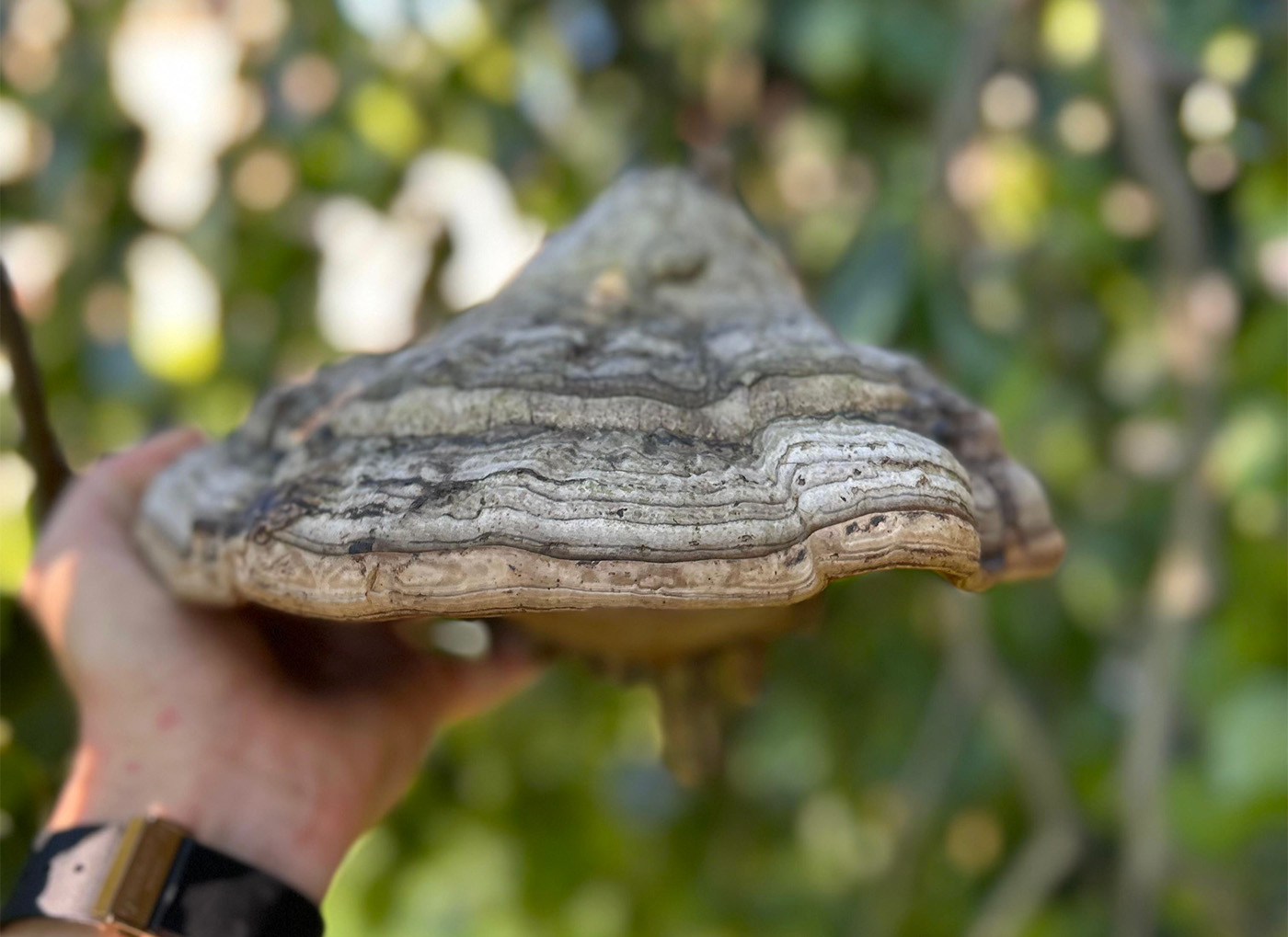
Chinese provinces such as Jilin, Yunnan and Zhejiang offer wood-decay mushrooms conditions that would be very hard to put together here: a humid climate, a woodland setting and plenty of natural substrate from broadleaf trees.
Most of the mushrooms are grown on organic farms with a natural growth cycle – typically on oak or mulberry wood, with nothing speeding them up and no chemical intervention. The mushroom thus goes through its whole usual development instead of being forced to reach full size in half the time.
- The result is fruiting bodies with a steady content of naturally occurring substances – polysaccharides, triterpenes and phenolic compounds.
3. How a fruiting body becomes an extract
What you finally buy is decided just as much by the growing as by the processing. Our Chinese partners work with gentle methods of extraction:
- dual extraction (hot water + ethanol)
- standardisation to the content of polysaccharides, triterpenes and beta-glucans
- control of temperature and purity at every step
Dual extraction is used because one solvent is not enough for a mushroom. Hot water draws out the water-soluble substances, typically polysaccharides including beta-glucans. Ethanol copes with those that will not dissolve in water – triterpenes, for example. The two liquids are then combined and concentrated, so both end up in the extract.
Standardisation means that the manufacturer states more than just “reishi extract” on a delivery; it also gives the proportion of the substances being tracked. Only then is there a figure you can work with when putting a recipe together.
Thanks to this, the extract genuinely matches what we state on the label – not dust with nothing in it.
4. What has to come with the raw material on paper
The extracts we use go through independent laboratory testing, and we receive documentation with every delivery:
- certificates of analysis (COA)
- tests for heavy metals, pesticides and microbial purity
- certifications such as GMP, ISO, HACCP, organic, HALAL and KOSHER
A certificate of analysis is an ordinary report: identification of the raw material, the content of the standardised substances and the results of the analyses. It is precisely because of that document that anything can be claimed about a raw material – and without it you are simply trusting what is written on the sack.
The suppliers we work with are at the same time suppliers to leading global brands, which demand the strictest standards of quality and safety. Those standards are not about advertising but about audits and an unbroken paper trail – and for us that is the main reason we have stayed with them.
5. Occurring in the wild is not the same as being available
Chaga grows quite commonly here – you will find the birch conk on living birches all over northern and central Europe, and cordyceps too has related species in the temperate zone. So the obstacle is not that the mushrooms are absent from Europe. It is that a forager in the woods will not deliver hundreds of kilos of raw material at a consistent quality, with the same content of substances and with evidence of origin – and the growing capacity that could manage it has not yet come about here.
With some species the gap is wider still. Mesima is grown mainly in Asia, and the know-how for it is there. Thanks to the Chinese organic farms we have access to these rarer species as well, and in a fully controlled environment.
A controlled environment here means some very practical things: we know what wood the mushroom grew on, when it was harvested and which batch the extract comes from. With material gathered in the wild, none of that could be documented.
That allows us to offer comprehensive product ranges with the greatest possible natural variety.
6. The Czech part of the recipe
China is the origin of the extracts, not of the whole product. The honey the extracts are stirred into comes from South Bohemia – and in the products of the EXTRA range it makes up most of what is in the jar. Importing raw material therefore concerns the part that cannot be grown in Czech conditions; the rest we take care of at home.
In closing
Choosing a supplier of extracts is not about geography but about quality, experience and trust. And that is exactly why we turn to proven Chinese manufacturers, who:
- have grown mushrooms on an industrial scale for decades
- use top-class extraction technology
- meet international quality standards
- supply raw materials to the biggest brands in the world
If these four things could be found closer to home, that is where we would be. For now, though, the best-documented wood-decay mushroom grows in Asia – and we would rather have a raw material whose origin we know than one that simply has a shorter journey to us.